E-Invoicing in the UAE: What Businesses Need to Know Before July 2026?
Last updated on May 13, 2026
Kesavaraman Pushparaj (Author)
Abdul Akbar (Reviewer)
The way businesses issue and manage invoices in the UAE is undergoing a major transformation. With the Ministry of Finance (MoF) introducing the nationwide e-Invoicing system, companies will soon need to switch from traditional paper or PDF invoices to structured electronic invoices. This change is not just about technology; it’s about compliance, efficiency, and building a stronger digital economy.
From July 2026, e-invoicing will become mandatory for VAT-registered businesses. Understanding how it works, who it applies to, and what steps to take now is essential for smooth compliance.
What is e-Invoicing?
E-invoicing in the UAE refers to the generation, exchange, and storage of invoices in a structured digital format (XML or JSON). Unlike scanned copies or PDFs, these invoices are machine-readable and can be validated instantly.
Why is the UAE implementing e-invoicing?
-
To simplify VAT compliance and minimize tax fraud
-
To reduce the administrative burden on businesses
-
To strengthen the country’s digital economy
-
To enhance transparency and efficiency in business transactions
From July 2026, all VAT-registered entities must issue and process e-invoices through accredited service providers, ensuring uniformity and compliance.
Understanding the PINT AE Data Framework in UAE E-Invoicing
The PINT AE Data Dictionary forms the technical backbone of the UAE’s e-invoicing system. It defines the standardized data fields and structure that electronic invoices must follow to ensure compliance, accuracy, and seamless system integration.
Instead of simple PDF invoices, businesses must generate structured, machine-readable invoices that include mandatory details such as supplier and buyer information, tax registration numbers, invoice identifiers, VAT breakdowns, and total values. The framework also applies validation rules to ensure data consistency and regulatory alignment.
By standardizing invoice data, PINT AE enables automated processing, interoperability between accounting systems, and secure transmission through Accredited Service Providers (ASPs), making structured compliance a key requirement for UAE businesses.
Background & Regulatory Context
The UAE government has laid down a clear roadmap for implementing e-invoicing.
-
Legal Framework: The initiative is backed by UAE VAT law, the Electronic Commerce Law, and Ministerial Decisions such as Decision No. 64 of 2025, which defines rules for accreditation of service providers.
-
MoF Objectives: To reduce invoice processing costs, improve tax collection, and enable real-time oversight of VAT transactions.
-
Timeline:
What is an “e-Invoice” under UAE rules?
Under the UAE framework, an e-invoice is not just a digital file; it must follow a specific structure and format.
-
Accepted formats: XML or JSON, aligned with PINT AE / Peppol standards.
-
Not accepted: Paper invoices, PDF scans, Word documents, or unstructured formats.
-
Mandatory fields: Supplier and buyer details, VAT number, invoice date, invoice value, tax breakdown, and other data required by the MoF.
Technical Requirements for UAE E-Invoicing
To comply with UAE e-invoicing regulations, invoices must meet specific structural and transmission standards.
Structured Digital Format
Invoices must be generated in a structured, machine-readable format (not just PDF). This ensures automated validation and data exchange between systems.
Mandatory Invoice Data Fields
Each e-invoice must contain the required elements, such as:
- Supplier and buyer tax details
- Unique invoice number
- Date of issue
- VAT information
- Line-item details
- Total payable amount
Transmission Through Accredited Service Providers
Invoices must be transmitted through an approved intermediary (ASP) that connects the business to the government reporting system.
Secure Storage & Archiving
Businesses must maintain secure digital records of issued and received invoices in compliance with UAE record-keeping requirements.
The 5-Corner Model of E-Invoicing in the UAE
1. Invoice Generation by Supplier
The process begins with the supplier creating an e-invoice in a structured format (XML/JSON) using their ERP or accounting system. The invoice must contain all mandatory fields required by the MoF, including supplier and buyer details, invoice number, date, VAT amount, and total value.
2. Submission to Supplier’s Accredited Service Provider (ASP)
The e-invoice is then sent to the supplier’s Accredited Service Provider (ASP). The ASP is a certified entity approved by the MoF/FTA that validates the invoice for compliance with UAE regulations. The ASP checks the invoice for accuracy, correct format, and completeness before forwarding it further.
3. Validation and Exchange via Buyer’s ASP
Once validated, the invoice is exchanged with the buyer’s ASP. The buyer’s ASP ensures that the invoice matches the expected format and confirms that all required data is present. This step guarantees interoperability between different systems and standardizes the invoice flow across businesses.
4. Receipt by Buyer
After passing through the buyer’s ASP, the buyer receives a fully compliant e-invoice that can be directly integrated into their accounting or ERP system. This reduces manual entry errors and accelerates the reconciliation process.
5. Data Reporting to Federal Tax Authority
Throughout this process, the invoice data is automatically reported to the Federal Tax Authority (FTA). This allows real-time monitoring of transactions, ensures VAT compliance, and reduces the risk of fraud or tax evasion.
ASPs are the backbone of the UAE e-invoicing system. They are officially accredited by the MoF/FTA and act as intermediaries between suppliers and buyers.
Their responsibilities include:
-
Validating invoices for accuracy and compliance
-
Securely transmitting invoices between parties
-
Reporting data to the FTA in real-time
Who Must Comply with E-Invoicing in UAE?: Scope and Applicability
The UAE’s e-invoicing mandate applies to a broad range of businesses, ensuring that VAT reporting is standardized and transparent across the economy. Understanding who is required to comply is crucial for businesses planning their transition.
Entities Required to Comply.
-
This includes companies involved in B2B (business-to-business) transactions, where invoices are exchanged between two VAT-registered entities.
-
B2G (business-to-government) transactions are also in scope, meaning businesses supplying goods or services to government entities must issue e-invoices.
By targeting these groups, the UAE ensures that the majority of taxable transactions are captured in real time, reducing the risk of VAT evasion and increasing compliance efficiency.
Transactions Covered
-
Standard commercial transactions between VAT-registered businesses.
-
Contracts and procurement with government entities (B2G).
-
Invoices must meet all mandatory data requirements and flow through Accredited Service Providers (ASPs) for validation and reporting.
Potential Future Extensions
While the initial rollout focuses on B2B and B2G, the UAE government may extend the e-invoicing framework to include B2C (business-to-consumer) transactions in the future. This could include retail sales, online services, or other consumer-facing operations, ensuring that VAT compliance is enforced across all types of transactions.
Benefits of E-Invoicing Services in UAE
Implementing e-invoicing UAE offers multiple advantages, from cost savings to improved compliance. Here’s why businesses should adopt it:
-
Lower Costs & Faster Processing
E-invoicing reduces manual data entry, printing, and mailing of invoices. Automation speeds up invoice approvals, minimizes errors, and lowers administrative costs, allowing finance teams to focus on strategic tasks.
-
Improved Cash Flow & Payment Cycles
Structured e-invoices enable faster validation and reconciliation. This leads to quicker payments, better working capital management, and enhanced predictability in cash flow for businesses.
-
Enhanced Tax Compliance & Fraud Control
Real-time reporting to the Federal Tax Authority (FTA) ensures accurate VAT calculation and reduces the risk of fraud. Digital invoices simplify audits and protect businesses from penalties due to non-compliance.
-
Better Decision-Making with Accurate Data
Standardized e-invoices provide actionable insights into sales, purchases, and tax liabilities. Businesses can monitor trends, optimize operations, and make informed decisions based on real-time financial data.
-
Environmental & Sustainability Benefits
Moving to digital invoices reduces paper consumption, storage needs, and the carbon footprint associated with traditional invoicing, supporting eco-friendly business practices.
Challenges & Risks in E-Invoicing
While beneficial, e-invoicing also poses challenges for businesses:
-
System readiness: Ensuring ERP/accounting software is compatible with structured formats.
-
ASP integration: Selecting and integrating with accredited service providers.
-
Data security: Protecting sensitive financial and client data.
-
Training & change management: Staff must adapt to new invoicing workflows.
-
Noncompliance risks: Penalties, VAT input rejection, and reputational damage.
Preparing for E-Invoicing UAE: Step-by-Step
Implementing e-invoicing services in the UAE requires careful planning and execution. Businesses can follow these key steps to ensure smooth compliance before the July 2026 deadline:
-
Conduct a Gap Assessment
Compare your current invoicing processes with the MoF requirements to identify gaps. Check if your ERP/accounting system captures all mandatory data fields, supports structured formats, and can integrate with an Accredited Service Provider (ASP). This assessment helps you plan upgrades and internal process changes efficiently.
-
Select an Accredited Service Provider (ASP)
Choose a MoF/FTA-approved ASP to validate, transmit, and report your e-invoices. Evaluate providers based on system compatibility, support services, security features, and ability to handle your transaction volume. Using a certified ASP ensures compliance and smooth invoice processing.
-
Upgrade ERP and Accounting Systems
Ensure your accounting or ERP software can generate e-invoices in the required XML/JSON format and integrate seamlessly with the ASP solution. Enable digital signatures and real-time data transmission to meet regulatory requirements, reducing manual errors and streamlining workflows.
-
Run Pilot Testing
Test your e-invoicing setup with sample invoices before going live. Pilot testing allows you to identify and fix errors, verify compliance, and train employees on new procedures. This step minimizes disruptions when the system becomes mandatory.
-
Train Employees and Update Policies
Educate finance, accounting, and IT teams on e-invoicing workflows, compliance responsibilities, and reporting standards. Update internal policies, define roles clearly, and ensure staff understand their responsibilities in generating, validating, and transmitting e-invoices.
Implementation Timeline of E-Invoicing in the UAE
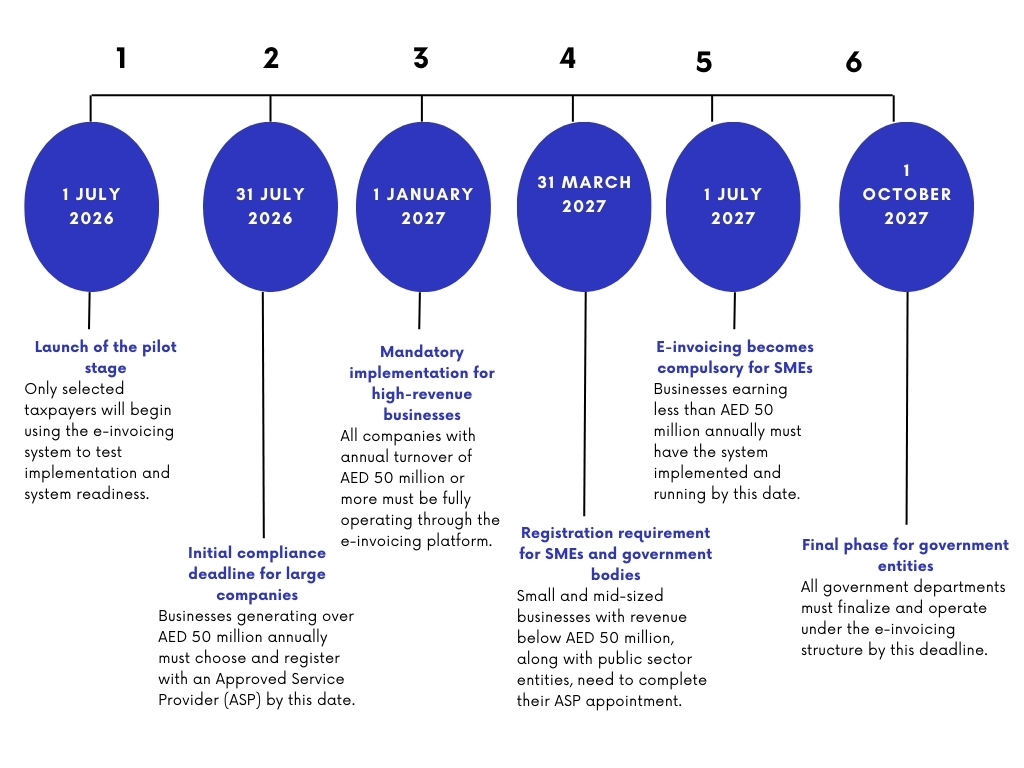
The UAE has introduced a phased rollout plan to ensure a smooth and structured transition to e-invoicing across all business categories. The implementation spans from July 2026 to October 2027, beginning with large enterprises and gradually extending to SMEs and government entities. The timeline below highlights the major deadlines businesses must follow to appoint an Approved Service Provider (ASP) and fully adopt the e-invoicing system.
Compliance & Penalties: Ensuring E-Invoicing UAE Readiness
-
Fines and Penalties from the Federal Tax Authority (FTA)
Businesses that fail to issue, transmit, or store e-invoices in accordance with MoF/FTA requirements may incur fines. The severity of penalties depends on the nature of non-compliance, such as missing mandatory fields, failing to use an accredited ASP, or delayed reporting.
-
Rejection of Invoices for VAT Purposes
Non-compliant invoices may be rejected for VAT claims, meaning input VAT cannot be recovered. This directly impacts cash flow and increases costs for businesses. Proper e-invoice generation and validation through an accredited ASP prevent such issues.
-
Increased Audit Risks
Inaccurate, incomplete, or improperly formatted invoices can trigger audits from the FTA. Audits are time-consuming and may result in additional fines or penalties if discrepancies are found. Maintaining structured, compliant e-invoices reduces audit exposure and streamlines regulatory checks.
-
Business Disruption Due to Invalid Invoice Data
Invalid or non-compliant invoices can disrupt operations, causing delays in payments, strained supplier relationships, and reconciliation issues. Ensuring that all invoices are validated and compliant minimizes operational risks and maintains smooth financial processes.
Role of GAAP Associates
At GAAP Associates, we provide complete e-invoicing services in the UAE to ensure our clients are well prepared before July 2026.
Our services include:
-
E-invoicing readiness assessments
-
Advisory on selecting accredited ASPs
-
ERP and accounting system integration support
-
Staff training & change management
-
Ongoing compliance monitoring and audit support
By partnering with us, businesses can achieve a seamless transition to the UAE’s new invoicing regime.
Conclusion
The shift to e-invoicing UAE is more than a compliance requirement; it’s an opportunity for businesses to improve efficiency, strengthen VAT reporting, and embrace digital transformation. With the July 2026 deadline approaching, VAT-registered companies should act now by assessing their systems, selecting Accredited Service Providers, and training teams for smooth implementation. While the transition may seem challenging, the long-term benefits, faster processing, better cash flow, reduced fraud, and sustainability far outweigh the initial efforts.
By choosing professional e-invoicing services in the UAE from GAAP Associates, businesses can simplify their compliance journey, avoid penalties, and position themselves for success in the UAE’s growing digital economy.

Kesavaraman Pushparaj
Chartered Accountant
UAE-based Chartered Accountant with expertise in statutory audits, IFRS reporting, UAE Corporate Tax, and VAT compliance. Experienced in supporting businesses with audits, tax filings, financial reporting, and compliance requirements across various industries.